
Things to Do in Teotihuacán: What I Saw, What It Cost & What I’d Do Differently

Teotihuacán wasn’t even the plan. We were heading to Mexico City, but the flight from Mérida into Felipe Ángeles airport (NLU) was so much cheaper than flying into the main Mexico City airport that we built a one-night stop near the pyramids around it. So this isn’t the polished “I always dreamed of standing beneath the Pyramid of the Sun” story. It’s the honest version: a cheap flight, a late-night arrival, a basic room I barely slept in, and a morning at one of the most famous archaeological sites in the world before we carried on into the capital.
I visited independently with my boyfriend — no tour, no guide, no fixed itinerary. If that’s how you like to travel, too, here’s exactly what we did, what it actually cost, and the things I wish someone had told me before we went.
Yes — but let me be specific about what “worth it” means here, because I think a lot of guides oversell it.
It’s worth it for the scale. Walking down the Avenue of the Dead with the Pyramid of the Sun rising ahead of you is the kind of thing photos genuinely undersell. The site is enormous and quiet in the early morning, and there’s a real sense of how big and organized this city was nearly two thousand years ago. That part lived up to everything I’d read.
What’s not worth building a whole trip around is the surrounding area. San Juan Teotihuacán, the town next to the site, is ordinary — useful for a bed and a meal, not a destination in itself. And our night there was rough: a basic, noisy room with fireworks going off at some point that meant I barely slept. The one genuinely lovely surprise was dinner — live music, dancing, good food. So my honest take is that Teotihuacán is absolutely worth a focused half-day, ideally as a day trip rather than an overnight, unless you’ve got a specific reason to stay close.
What activities can you do in Teotihuacán?
The site itself is the main event, and there’s more to it than the two big pyramids everyone photographs. The whole place was a city of maybe 200,000 people at its peak, built and abandoned centuries before the Aztecs ever saw it — they’re the ones who later named it. Here’s what’s worth your time, roughly in the order you’ll hit it walking from the southern entrance northwards.
Walk the Avenue of the Dead
This is the long central spine of the city, around two kilometers of it, lined with platforms and smaller structures. Start here — it orients you and gives you that first proper view of the pyramids. It’s about 40 meters wide, dead straight, and slightly off true north, so it lines up with the mountain Cerro Gordo at the far end. The Aztecs assumed the platforms running along it were tombs, which is where the morbid name comes from, but they weren’t — this was the city’s busy heart. Walking the full length and back is most of your visit right here, so pace yourself and don’t burn out before you reach the pyramids.
The Pyramid of the Sun
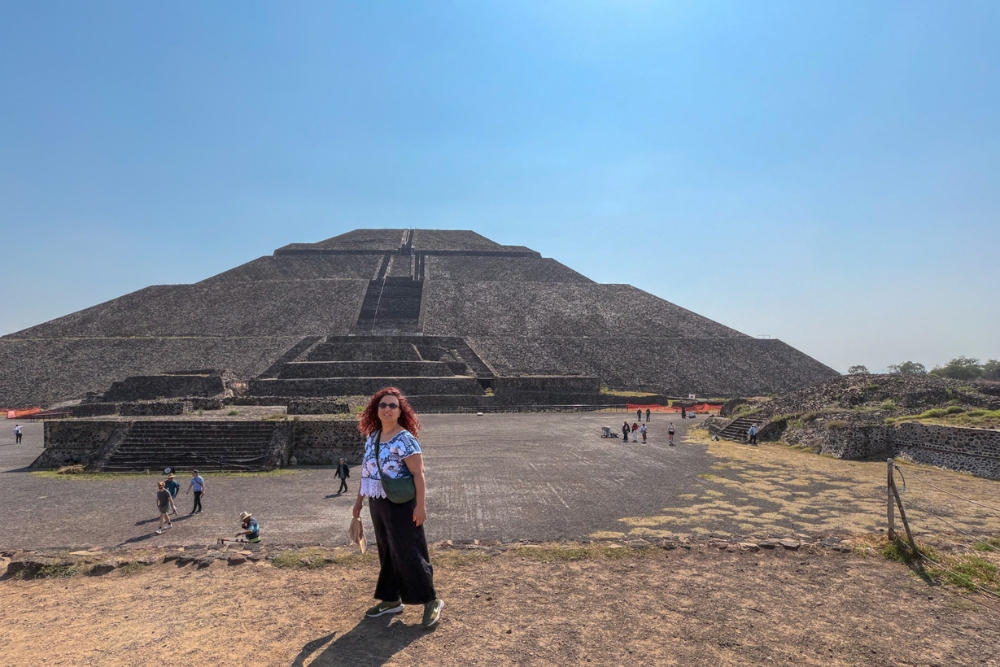
The giant. It’s one of the largest pyramids in the world by volume, and even from the base, it’s genuinely imposing — around 65 meters tall, which is taller than a 20-story building, and only a little shorter than the Great Pyramid of Giza. It was built around 200 AD, sits on the east side of the Avenue, and its scale doesn’t really land until you’re standing right underneath. Climbing access to it has been restricted in recent years, so check the current rules at the gate before you assume you can go up. Even if you can’t climb, walking around the base and seeing it from different points along the Avenue is worth the time.
The Pyramid of the Moon
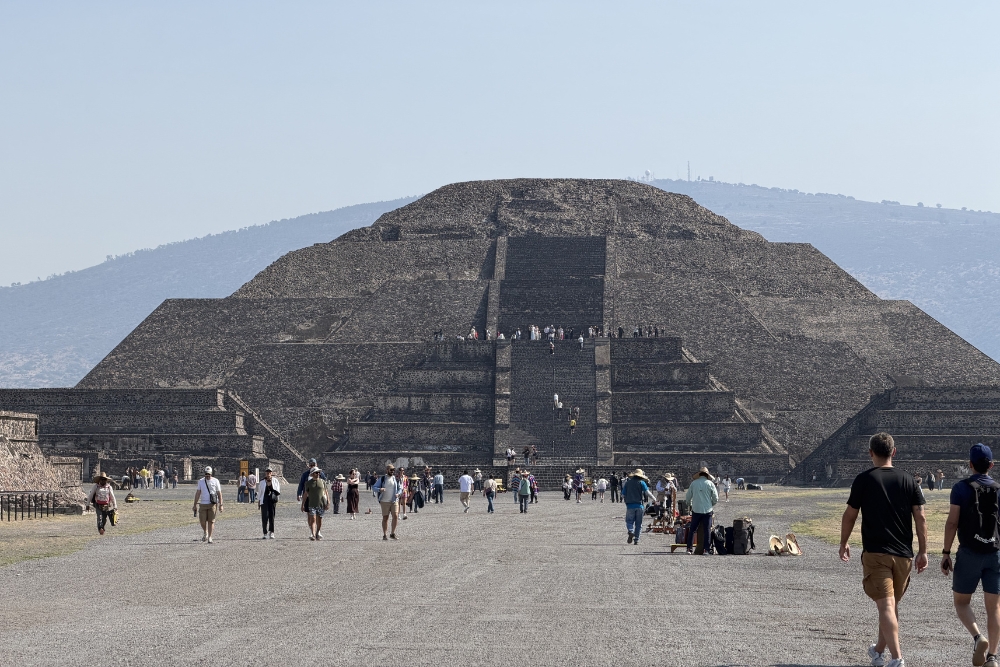
Smaller at around 43 meters, but it sits at the northern end of the Avenue and frames the whole site beautifully when you look back down it. That view back along the Avenue, with the Pyramid of the Sun off to one side, is the photo most people come for, and it’s better from up here than from anywhere else on site. Partial climbing reopened here in 2025 — again, confirm what’s open on the day, because the rules change. The plaza in front of it is a good spot to stop, catch your breath, and take it all in before you turn back.
The Temple of Quetzalcóatl
Tucked inside the Ciudadela complex at the southern end of the site, this one has the most detailed stonework on the whole site: rows of carved feathered-serpent heads jutting out from the stepped facade, alternating with another goggle-eyed figure. It’s the closest you’ll get to fine detail at Teotihuacán, where most of what survives is sheer mass rather than carving. It’s quieter than the big pyramids and easy to rush past, which would be a mistake — if you come in from the south, see it first while you’re fresh, because by the time you’ve done the Avenue and both pyramids, you may not want to double back.

The site museum and murals
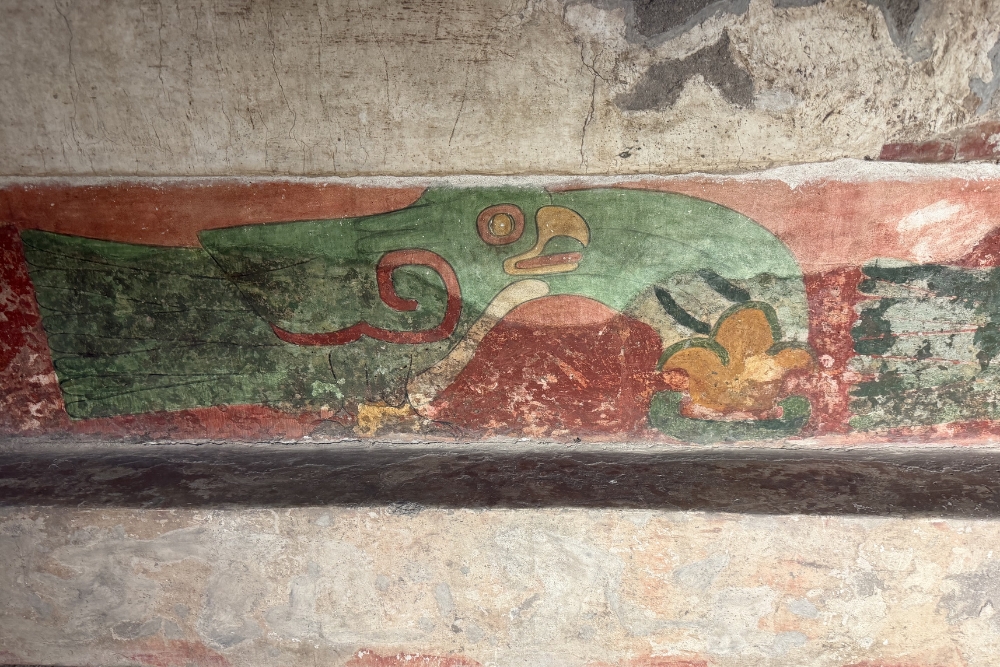
Included with your entry ticket, so there’s no reason to skip it. Good context for what you’re actually looking at out there, plus a large-scale model of the city that helps the layout click into place. There’s also some surviving color from the original painted surfaces — the whole site was once plastered and painted, which is hard to picture when you’re looking at bare stone. Twenty minutes here, before or after the walk, does a lot to help understand the rest.
A sunrise hot-air balloon flight
This is the iconic add-on you’ll see all over Instagram — floating over the pyramids at dawn, with the balloons catching the first light. I didn’t do it (it’s a separate, pricier activity you book in advance, and flights go up very early), but if your budget stretches, it’s the one splurge people rarely regret. You’re in the air before the site even opens to walkers, so you get the pyramids from above and to yourself. Book ahead, especially in peak season, and be ready for a pre-dawn start.

© AmigoTours
The craft and obsidian stalls
Teotihuacán is known for obsidian — the volcanic glass was worked here in huge quantities in ancient times, and you’ll see it everywhere in the stalls now, from carved figures to jewelry. I’ve moved away from buying typical souvenirs and towards things I’ll actually wear, so if you’re the same, look at the jewelry rather than the trinkets. A few stalls also sell agave products and local mezcal. Prices are negotiable, and quality varies a lot, so take a minute before you buy.
We came in through Gate 3, which kept us close to the main structures.
How much time is needed to see Teotihuacán?
We spent about two hours, and that was enough to walk the Avenue of the Dead, see both main pyramids, and take our time with photos. If you want to add the museum, the Temple of Quetzalcóatl properly, and a slower pace, give yourself three to four hours.
Honestly, the limiting factor isn’t distance — it’s the sun. The site is open and exposed, with very little shade, so two focused hours in the morning felt better than dragging it out into the heat of the day. Go early, see the highlights, and you won’t feel like you missed anything.
Can I visit Teotihuacán without a tour?
You can, and I did. Visiting independently is cheaper, and you go at your own pace instead of being herded between photo stops on someone else’s schedule. For a site that’s this easy to reach by bus or rideshare, I’d recommend it for anyone comfortable finding their own way around.
The one trade-off worth being honest about is context. A guide hands you the history as you walk; on your own, you either read up beforehand or you’re looking at impressive structures without fully understanding what you’re seeing. I’d rather spend twenty minutes reading the night before than pay for a tour, but that’s a personal call. If you do want a guided visit, you’ll find plenty through certified local operators or platforms like GetYourGuide, often with transport included and skip-the-line entry.
Is there a bus from the Teotihuacán pyramids to Mexico City?
I’ll be straight with you: we didn’t take the bus back. We were heading straight into the city center with our bags, so we took a DiDi instead — about an hour, roughly 300 pesos plus 116 pesos for the toll road. But if you’re watching your budget and not weighed down with luggage, the bus is the smarter choice by a wide margin.
But yes, there is also a bus, and it’s the budget option I’d point most people towards. Buses run by Autobuses Teotihuacán (look for the ticket booth marked “Pirámides”) connect the site with the Terminal Central de Autobuses del Norte in Mexico City. That terminal sits right next to the Autobuses del Norte metro station on Line 5, so it’s easy to continue into the city.
Buses leave roughly every 20 to 30 minutes, and the trip takes about an hour. For the return, the bus picks up just outside Gate 2 — bring cash, because you pay the driver, and they sometimes charge a little more than the outbound fare. Expect between 50 and 135 pesos, depending on whether you buy a single or a return ticket.
How much does an Uber cost from Mexico City to Teotihuacán?
A rideshare between Mexico City and Teotihuacán usually runs in the few-hundred-peso range each way, depending on traffic, time of day, and surge pricing. For comparison, our DiDi from the pyramids into the city was around 300 pesos plus the 116-peso toll — so budget similar in the other direction, sometimes more in heavy traffic.
Where the rideshare maths really bites is the airport. From Felipe Ángeles airport (NLU) to our hotel by the pyramids, DiDi quoted 500 to 600 pesos, and Uber was even more. It’s a 22-kilometer ride, but the road was so bumpy and slow — capped around 40 km/h — that it took over an hour, which makes those quotes feel even steeper.
So here’s the hack we actually used: we took the Mexibús, the Bus Rapid Transit system serving the State of Mexico, for 10 pesos to the Militar station, then a short taxi from there. Ten pesos versus five hundred. The catch was that the ticket machines weren’t working properly, and we’d have been stuck without the locals who tapped their own cards for us in exchange for cash. That kind of small kindness got us moving when nothing else would.
Compared against a bus at 50-something pesos, you can see why I’d only reach for an Uber or DiDi here when I’m carrying luggage or short on time.
What to know before going to Teotihuacán?
A few things from experience that would have made our trip smoother:
- Book accommodation early if you’re staying overnight. The good places near the site were sold out, which is how we ended up in a basic, noisy room. Lesson learned.
- Bring cash. Entry is cash-only at the booth — I paid 210 pesos as a foreign visitor (the rate went up at the start of 2026). The return bus is cash too. There’s a discounted rate for Mexican nationals and free entry on Sundays for nationals and residents, so check what applies to you.
- The budget transport hacks genuinely work, but they require time and patience. A 10-peso Mexibús beats a 500-peso rideshare every time, as long as you’re not in a rush and can roll with broken ticket machines.
- Go early. Shade is scarce, crowds build through the day, and the morning light over the Avenue of the Dead is the best you’ll get.
- Manage your expectations for the journey in. On the drive into Mexico City, we passed cactus plantations and a cable car running over dense hillside neighborhoods — and the city itself hit me as loud and chaotic the moment we arrived. Teotihuacán is calm and open; Mexico City is the opposite. Brace for the contrast.
Teotihuacán was never meant to be a highlight of this trip — it was a cheap flight and a stopover. It ended up being one of the calmest, most striking mornings of the whole journey, and the kind of place I’m glad I saw on my own terms rather than through a bus window on a tour.
