
Getting Around Uzbekistan: Every Transportation Option You Need to Know
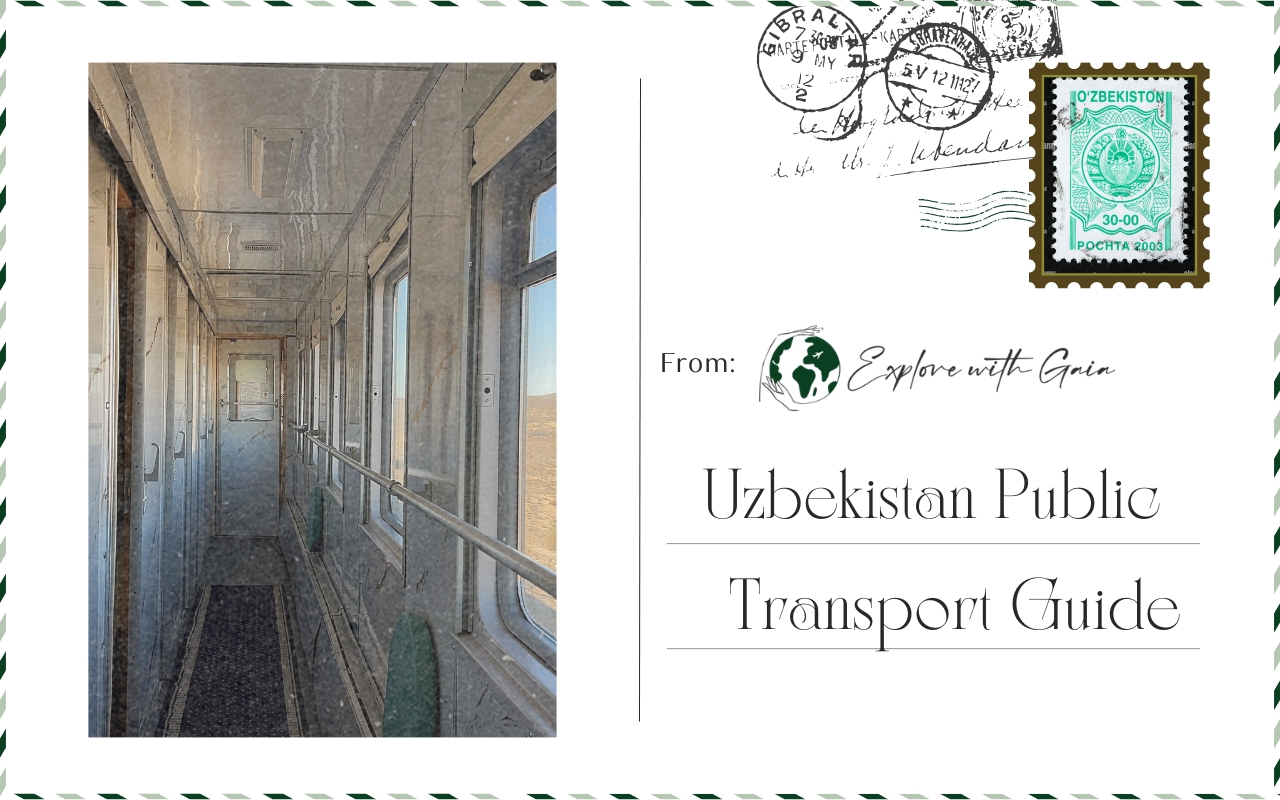
I organized every single leg of my two-week Uzbekistan journey myself—train tickets through the not-so-well-functioning railway website and at the train station ticket counters, Yandex taxis at 6 AM, negotiations with drivers to take us from Urgench to Nukus, and even finding and booking the Aral Sea tour independently. No tour operators, no travel agencies, no pre-arranged transport packages. Just me, a somewhat functional railway booking system, and a lot of determined problem-solving.
Here’s the truth about getting around Uzbekistan independently: it’s completely doable, surprisingly affordable, and occasionally chaotic. But when you’re standing on a former seabed after organizing your own Aral Sea transport, or watching the sunset from a train you booked yourself, the independence feels incredible. Here are all the transportation options available in Uzbekistan, how to book them, and what they’ll cost you.

© Gayane Mkhitaryan, Nasaf (Regional Express Train)
Trains (The Main Intercity Option)
Uzbekistan’s railway system is the backbone of intercity travel, and I booked every single train ticket myself through the official website (with varying degrees of success and frustration) and ticket officers. The Soviet-era infrastructure has been modernized along major routes, providing comfortable, affordable travel between Silk Road cities.
Types available:
- Nasaf/Sharq (Modern Express): Fast, comfortable, air-conditioned trains connecting major cities. I took the 9:12 AM Nasaf from Tashkent to Samarkand (2.5 hours) and the 12:15 PM Sharq from Samarkand to Bukhara (3.5 hours). These trains offer a meal service, feature electrical outlets, and resemble European intercity trains. The main routes are Tashkent-Samarkand and Samarkand-Bukhara.
- Afrosiyob (High-speed): The fastest option with the most modern carriages, though limited to main routes. Think of it as Uzbekistan’s answer to European high-speed rail.
- Passenger trains (Older): Slower, cheaper, with more local atmosphere. My Bukhara-Khiva journey took 7-8 hours on one of these. They’re less comfortable than express trains but give you an authentic glimpse of local travel culture. Bring snacks and entertainment.
- Approximate costs: €8-15 between major cities
Booking options:
- Official website: https://railway.uz/en/ (my primary method, though it crashed on me three times before finally processing payment)
- At station ticket machines: An easier interface, but it requires navigating language barriers and Cyrillic signs.
- At the station ticket offices: long queues, language barriers, but I’d say the most successful one
Through hotels/guesthouses: I haven’t tried this option, but they charge €3-5 commission, but it would save you hours of website frustration for sure
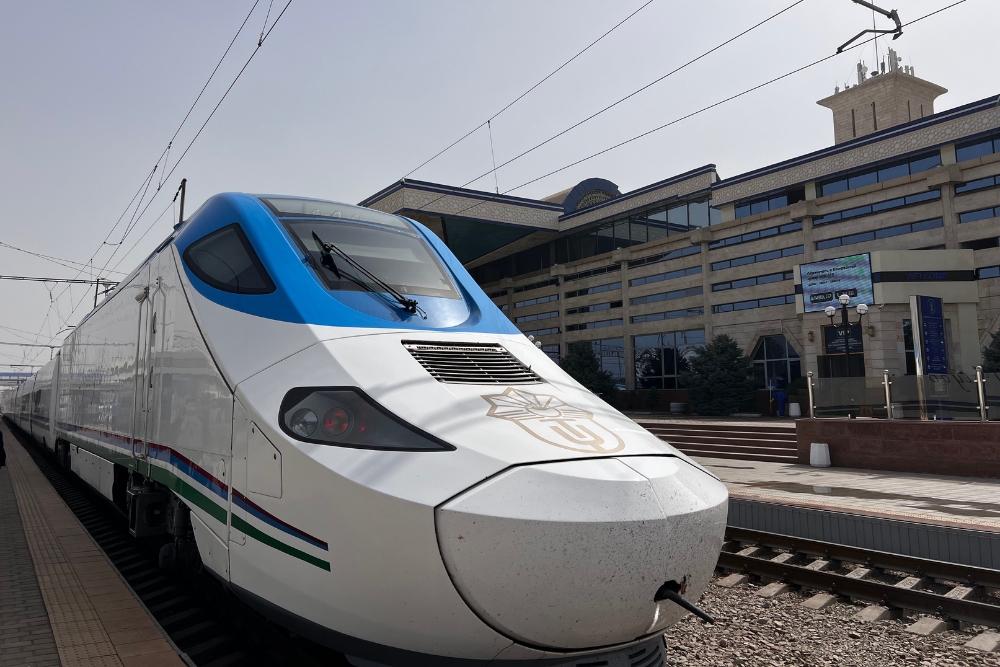
© Gayane Mkhitaryan, Afrosiyob (High-Speed Train) in Samarkand Station
Buses and Marshrutkas
Buses fill gaps where trains don’t go, though I relied primarily on trains for my main routes. The bus network is extensive but less tourist-friendly than the train system—expect Cyrillic-only signs, flexible schedules, and a high volume of local passengers.
Types available:
- Long-distance buses connect major cities and are well-suited for routes with infrequent train times. They’re cheaper than trains, but journey times are longer due to road conditions and frequent stops. Modern buses typically have air conditioning, whereas older ones often don’t.
- Marshrutkas (minibuses): Soviet-era shared minivans that serve as the primary mode of transportation for locals between smaller towns. These wait at stations or designated spots until complete (usually 10-15 passengers) before departing. Fixed routes, very cheap, and an authentic experience. I watched locals use these constantly, but stuck with trains for longer distances.
Approximate costs: €5-10 for long-distance buses, €1-3 for marshrutkas
Booking options:
- Long-distance buses: At bus stations (booking rarely needed except on peak travel days)
- Marshrutkas: No booking system—show up at the departure point, board, and pay the driver
- Some routes: Bookable through local travel agencies if you want certainty
Reality check: Marshrutkas are cramped, schedules are flexible (read: they leave when full, not at specific times), but they’re budget-friendly and you’ll be traveling exactly how locals do.
Shared Taxis (Faster but Requires Negotiation)
Shared taxis are a standard option for routes where you prefer a comfortable ride. I negotiated directly with drivers for our Urgench-Nukus journey—it took persistence, basic Russian phrases, and about twenty minutes of gesturing, but it worked perfectly once arranged.
How they work: Drivers congregate at taxi stands near train stations or markets, waiting until their car fills with usually four passengers heading the same direction. You can pay for multiple seats to leave immediately, rather than waiting. Price negotiation is expected and part of the process.
Approximate costs: €20-40 per person, depending on distance and negotiation skills (€50-80 if you pay for the whole car to leave now)
Booking options:
- In person at taxi stands: My method—ask locals “где такси?” (Where are taxis?) and they’ll point you to the congregation spot
- Through hotel recommendations: Staff can call drivers they know and arrange pickup
- Ask around: Other travelers, guesthouse owners, and even restaurant staff know which drivers do which routes
- Telegram groups: Some cities have ride-sharing groups, though these require Russian language skills
My experience: Finding drivers willing to make the Urgench-Nukus run required walking to the area near the train station and asking multiple drivers. Most wanted to wait for more passengers; we eventually found one willing to go for a negotiated price. Once arranged, the journey was smooth and significantly faster than the bus alternative. As our train from Urgench to Nukus was delayed for more than four hours, this was the only reasonable alternative: we paid 450,000 UZS in cash. The main issue here is that Yandex taxi drivers will cancel once they see it’s an intercity trip, as they pay higher commissions. Additionally, I’d need a Russian-speaking driver so we can communicate more easily on the road, for example, if I need to stop somewhere.
Domestic Flights (When Distance Matters)
I actually took the overnight train from Nukus back to Tashkent—partly because I wanted the full travel experience, partly to save money on a hotel night since I’d be sleeping on the train anyway. However, I watched numerous tourists at Nukus airport choosing the flight option instead, and I completely understand why. That 12+ hour overnight train journey isn’t for everyone, especially after camping at the Aral Sea. Domestic flights make sense when you’re covering a serious distance, have limited time, or simply don’t want to spend half a day on a train.
Main routes: Tashkent is connected to Urgench, Nukus, Samarkand, and Bukhara, although frequencies vary significantly. The Tashkent-Urgench route is the most popular, as it serves tourists visiting Khiva.
Approximate costs: €40-80, depending on route and how far in advance you book
Booking options:
- Uzbekistan Airways official website: Most reliable for domestic flights
- Booking.com flights section: Sometimes shows better prices
- At the airport: Possible for last-minute bookings but not recommended—limited availability and higher prices
Reality: Basic service without frills, but schedules are reliable and you’ll save half a day or more of travel time for distant destinations like Nukus.
Private Car Hire with Driver
For day trips or areas where public transport simply doesn’t exist, hiring a car with a driver becomes necessary rather than optional. Even for the Aral Sea—the only organized tour I booked—I found and arranged it myself through research and direct contact with operators in Nukus. The tour included the vehicle and driver for the entire two-day journey.
When you actually need this:
- Aral Sea tours from Nukus (no public transport to the former seabed)
- Ayaz Kala yurt stays from Khiva (desert location)
- Day trips from Samarkand to Shakhrisabz
- Any rural destination beyond the marshrutka networks
Approximate costs: €80-150 per day, depending on distance, vehicle type, and whether fuel is included
Booking options:
- GetYourGuide, Headout, Viator, and Klook. I booked the tour via GetYourGuide after researching and comparing prices and services.
- Tour operators in cities: I wish I had booked it directly with the Aral Sea Discovery Company, but I wanted some security, which is why I booked it via GetYourGuide.
- Through accommodations: Guesthouses have driver contacts and can arrange day trips.
- Direct negotiation with drivers: Possible, but language barriers are significant.
My Aral Sea experience: I found the tour operator through online research before arriving in Nukus, then confirmed details and paid directly. The €150-200 tour cost included transport, driver, camping equipment, and meals for the two-day journey—essentially a private car hire combined with a guide.

© Gayane Mkhitaryan, Aral Sea, Karakalpakstan, Uzbekistan
City Transportation Options
© Canva
Yandex Taxi (My Go-To App)
Yandex Taxi became my lifeline for city transport—I used it constantly in Tashkent, Samarkand, Bukhara, and even for that chaotic 6 AM Bukhara pickup when I nearly missed my train. Download it before arrival and set it up; it works exactly like Uber but actually functions reliably in Uzbekistan.
How it works: The app displays the price before you confirm the booking, so there’s no negotiation or unexpected costs. Drivers arrive within 5-10 minutes in cities. You pay by card or by cash directly to the driver at the end. There’s no language barrier since the app handles communication—you just show the driver your phone screen.
Approximate costs:
- Within city centers: €1-3
- Airport transfers: €3-5
- Khiva old town to train station: €2-3
- Longer cross-city journeys: €5-8
Set up requirements:
- Download the app before arrival
- Phone number verification (having a local SIM makes this smoother)
- Keep cash ready—drivers consistently prefer cash despite app payment options.
My reality: This app saved me countless times, especially for early morning departures when finding street taxis would’ve been impossible or required booking through hotels. The only thing I wish we had was the pre-booking option, as I had in Bucharest via the Bolt taxi.
Street Taxis (Negotiation Required)
Official taxis and informal drivers (locals using personal cars as taxis) wait near train stations, major tourist sites, and hotels. I used these occasionally when Yandex wasn’t showing available drivers or when hotels pre-arranged pickups for specific times.
How it works: You negotiate the price before you get in the car—no meters exist. Drivers will quote an initial price; you counter with roughly 50-60% of that, and you’ll usually settle somewhere around 70% of the original quote. It’s expected, not rude.
Approximate costs: €2-5 within cities after negotiation (they’ll start at €5-8)
Booking options:
- Wave one down near tourist areas or hotels
- Ask your accommodation to call a driver they trust
- Use the hotel reception to arrange specific pickup times
Tashkent Metro (Soviet Architectural Marvel)
Tashkent’s metro is the only subway system in Central Asia, and it’s spectacular—Soviet-era stations decorated with elaborate mosaics, chandeliers, and marble celebrating space exploration, cotton harvests, and Uzbek culture. I used it extensively to navigate Tashkent efficiently while also treating the famous stations as tourist attractions in their own right.
- Coverage: Comprehensive network across Tashkent, connecting major sites, bazaars like Chorsu, museums, and railway stations. Three main lines with clear connections.
- How it works: Purchase a plastic token (жетон/zheton) at station kiosks for each journey. Tap through turnstiles, keep the token, and use it to exit at your destination. Multiple lines intersect at transfer stations with clear signage in Uzbek, Russian, and sometimes English. But you can also tap and go with your credit card, which is more convenient.
- Approximate costs: Less than €0.30 per journey—absurdly cheap
- Bonus: Photography restrictions have relaxed significantly, but I still asked permission before photographing. Stations like Kosmonavtlar (space-themed with stunning mosaics) and Alisher Navoi (honoring the Uzbek poet with intricate decoration) are genuinely worth visiting as tourist attractions, not just transport.
- Navigation: Station names appear in Uzbek, Russian, and some English. Download a Tashkent metro map to your phone before arrival—the offline version saved me multiple times when data was patchy.
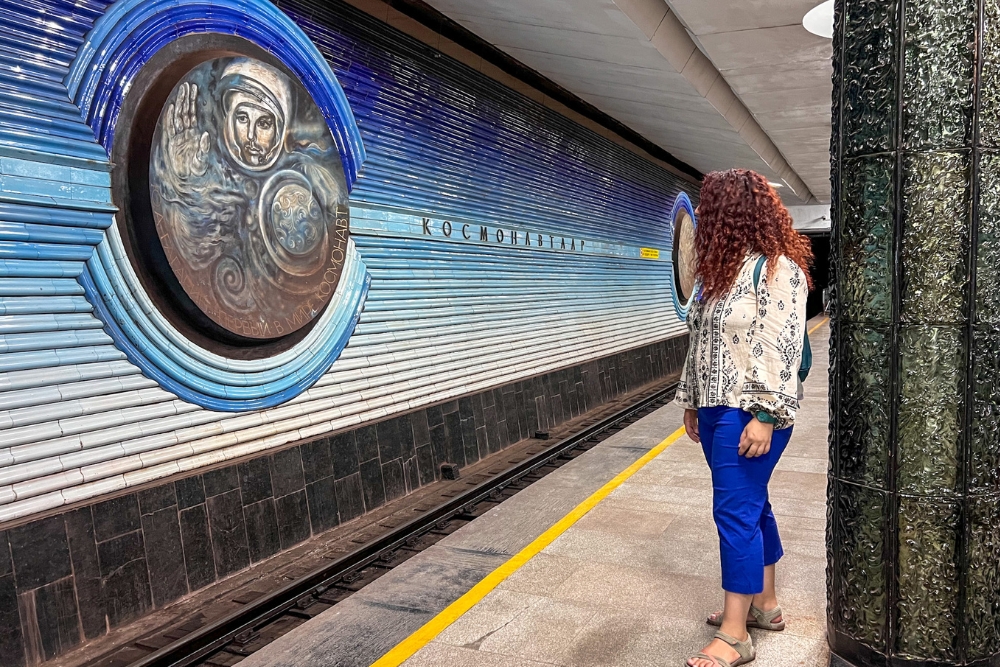
© Gayane Mkhitaryan, Kosmonavtlar (Космонавтлар) – The Space Station
Walking (The Best Way to Explore Old Towns)
Once inside the historic old towns of Samarkand, Bukhara, and Khiva, walking becomes the only way to properly explore. These are compact, pedestrian-friendly centers where you’ll cover all major sites on foot and discover the hidden courtyards, artisan workshops, and small tea houses that make these cities magical.
Reality check:
- Cobblestones everywhere—comfortable walking shoes are essential, not optional
- Khiva’s walled city (Itchan Kala) isn’t accessible to vehicles at all, so be prepared for a short hike
- Summer heat requires early morning starts; September-October is perfect walking weather
- Distances are deceptive—what looks like 10 minutes on a map takes 20 when you’re stopping to photograph doorways
No cost, maximum atmosphere, and you’ll discover details impossible to notice from any vehicle.
Practical Transportation Tips I Learned
Booking & Planning:
- Book trains 3-5 days ahead during peak season (September-October): The railway website worked better with advance notice, and popular routes like Samarkand-Bukhara fill up quickly.
- Screenshot everything: Confirmation numbers, ticket details, driver phone numbers, addresses in Cyrillic—my phone became my backup filing system when websites logged me out unexpectedly.
- Download Yandex Taxi before arrival: Setting it up requires phone verification and payment setup, much easier to handle before you’re desperate for a ride at 6 AM.
- Learn basic Russian transport phrases: “вокзал” (vokzal = train station), “когда?” (kagda = when?), numbers 1-100, and “сколько стоит?” (skolka stoit = how much?) got me through countless interactions.
Money & Payment:
- Carry small bills for buses and marshrutkas: Drivers rarely have change for 50,000 or 100,000 som notes.
- Yandex Taxi requires cash payment for long-distance rides: Despite card options showing in the app, every driver I met preferred cash, and some insisted on it.
- Train tickets can be paid for at stations with a card, but the website payment system is unreliable—sometimes it works, sometimes it crashes after the fifth attempt.
- Negotiate taxi prices before entering the vehicle: My rule became offering 50% of the first quote, then settling around 70% after some friendly back-and-forth.
Timing & Logistics:
- Factor in “Uzbekistan time”—everything takes 30% longer than expected: Travel time, finding taxis at stations, navigating to platforms, waiting for marshrutkas to fill.
- Early morning departures need 45+ minutes of buffer time: My Bukhara near-miss taught me this the hard way—I was literally running with my backpack and luggage.
- Station facilities vary wildly: Tashkent has cafes, clean toilets, and waiting areas; smaller stations have essentially nothing.
- Bukhara’s walled city complicates taxi logistics significantly: Cars can’t drive through medieval gates, so arrange pickup points OUTSIDE the walls the night before and confirm the exact location.
Safety & Comfort:
- Trains are safe, comfortable, and foreigner-friendly: I felt completely secure as a solo traveler on every train journey.
- Shared taxis require more street smarts: Trust your instincts, travel during daylight when possible, and don’t be pressured into arrangements that feel wrong.
- Tashkent metro prohibits large luggage during rush hours (8-9 AM, 5-7 PM): Plan museum visits separately from airport transfers if you have a big backpack.
- Download offline maps for every city: Google Maps works reasonably well but mobile data is patchy between cities and nonexistent in rural areas.
What I Wish I’d Known:
- The railway website crashes less at night: I successfully booked most tickets between 10 PM and midnight when server load was presumably lower.
- Guesthouses charge €3-5 to book trains, but it’s absolutely worth it: They could have saved me hours of website frustration and confirmation uncertainty.
- Urgench-Nukus shared taxis congregate near the train station: I spent thirty minutes asking locals before someone pointed me to the right spot.
- Yandex Taxi drivers call you when they’re en route: Having a local SIM made communication infinitely easier—they’d call to confirm location or say they’d arrived.
- Research and book special tours (like the Aral Sea) before arriving in smaller cities: I found better options and prices by researching online beforehand rather than relying on whoever approached me in Nukus.
Approximate Transportation Budget
Based on my actual spending over two weeks:
Intercity Transport:
- Tashkent-Samarkand train (Nasaf): €10-12
- Samarkand-Bukhara train (Sharq): €10-12
- Bukhara-Khiva train (Passenger): €8-10
- Urgench-Nukus shared taxi: €25-30 per person
- Nukus-Tashkent flight: €50-70
- Total intercity: €100-135
City Transport (daily average over two weeks):
- Yandex taxis: €5-10 per day
- Tashkent metro: €0.50 per day
- Occasional marshrutka or street taxi: €1-2
- Total for two weeks: €50-70
Day trips and special transport:
- Aral Sea tour (including transport, guide, camping, meals): €350-400
- Private car hire (if needed for other day trips): €80-150
Note: You can absolutely do it cheaper using more buses and marshrutkas instead of trains, or spend more for additional flights and private cars. This reflects my mid-range approach, prioritizing comfort on long journeys while using budget options in cities.
Essential Transportation Apps and Tools
Must-Downloads Before Arrival:
- Yandex Taxi: City transport lifesaver that works in every major Uzbek city
- Google Maps: Download offline maps for each city/town—works reasonably well for navigation
- Maps.me: Backup offline mapping app, sometimes more detailed than Google in smaller towns
- Google Translate: Camera feature for photographing and translating Cyrillic signs instantly
- Uzbekistan Railways app: Alternative to the website, equally temperamental but sometimes works when the site doesn’t
Useful But Not Essential:
- 2GIS: Local mapping app showing detailed business information, but the interface is entirely in Russian
- Yandex Maps: Shows marshrutka routes and numbers locals actually use
Conclusion
Uzbekistan’s transportation system is easily navigable without the need for tour operators or pre-arranged packages. The trains work beautifully once you master the booking system, Yandex Taxi solves 90% of city transport needs, and even negotiating shared taxis is more achievable than it sounds when you’re standing there with Google Translate ready. You’ll need patience, offline maps, basic Russian phrases such as “where” and “how much,” and a generous buffer time for everything. But the independence, the significant budget savings compared to organized tours, and the deep satisfaction of figuring it out yourself make every occasionally chaotic moment absolutely worth it.
My advice? Book your trains 3-5 days in advance through the website, preferably late at night when it’s less temperamental. Download Yandex Taxi the moment you land. Carry small bills at all times. Research special tours, such as the Aral Sea, before arrival. And be prepared to accept that not everything will go exactly according to plan. That’s precisely when the best travel stories happen—and when you’ll feel most proud of navigating this fascinating country completely on your own terms.
