
Things to Do in Râșnov, Romania: The Transylvania Stop You Didn’t Know You Needed

I almost didn’t stop in Râșnov. We were in a taxi leaving Bran Castle — a bit underwhelmed, a bit touristy-fed-up — when the taxi driver said “there’s another fortress on the way back to Brașov.” It wasn’t on my itinerary. I’d never really thought about it. But we told the driver to pull over, and two hours later I was standing on medieval ramparts looking out over the Carpathian Mountains thinking: this is what I came to Transylvania for.
We caught an old Regio train back to Brașov afterward — ancient carriages, a handful of locals, mountain views out the window. The ticket cost 6 lei. The whole detour cost almost nothing. It was one of those days that remind you why you travel without a fixed plan.
Also, there is a Hollywood-style “Râșnov” sign bolted onto the hillside above the fortress. Yes, like the Hollywood sign. It’s a bit kitsch. It also makes for a genuinely funny photo, so lean into it.

Short answer: yes, and it’s better than Bran Castle for most travelers.
Bran has the Dracula myth, the gift shops, and the crowds. Râșnov has actual medieval history, better views, fewer tour groups, and a fortress that tells a real story rather than a manufactured one. The two are only 9 miles apart, so there’s no reason to choose — but if you’re pressed for time, Râșnov is the one that will stay with you.
One honest thing to know before you go: the fortress’s interior is currently undergoing restoration. The garden and grounds are open for visits, with tickets purchased at the entrance. Interior access is restricted. Check the official site (https://cetatea-rasnov.ro/) before visiting to confirm the current status.

© Gayane Mkhitaryan, Râșnov Ascensor cetate, (funicular Citadel), Romania
Râșnov Fortress (Cetatea Râșnov)
This is the main reason to come, and it makes the trip worthwhile.
The fortress sits on a limestone hilltop 200 meters above the town — you can walk up the cobbled path or take the funicular (Râșnov Ascensor) from the town center. The cable car costs 60 lei for a return trip for adults; the ticket is valid for 3 days, and the ride up takes under a minute. Either way, the approach is part of the experience. The walls emerge from the treeline as you climb, the orange-tiled rooftops visible above the stone ramparts, mountains behind. It looks exactly like what it is: a medieval citadel that has survived 700 years.
What makes Râșnov different from a castle like Peles or Bran is its purpose. This was never a royal residence. It was built as a place of refuge for ordinary townspeople during invasions — farmers, craftsmen, families with children, bringing their cattle inside the walls and sitting out sieges that sometimes lasted months. Inside, there were at least 30 houses, a school, a chapel, and craftsmen’s shops. The wall thickness in the southern section reaches 1.5 meters. The north, south, and west faces drop away on 500-foot steep slopes. It was, for centuries, genuinely unbreakable.
Inside the restored buildings, you’ll find the Feudal Art Museum, which displays medieval armor, weapons, tools, and a skeleton beneath a glass floor. The inner rooms connect through wooden ladders and passageways. Even in partial restoration, the place has texture — you’re not just looking at things, you’re in something.
From the highest point of the ramparts, the views over the plains and the Southern Carpathians are the best I saw during my time in Transylvania.


Dino Parc Râșnov
Nobody tells you about this before you arrive, and we didn’t visit it either. But right next to the fortress, there’s a dinosaur theme park — the largest in Eastern Europe, with 100 life-size models made from fiberglass, scientifically certified, each one based on the latest palaeontological findings. The path winds through greenery, and the models are genuinely detailed.
Sounds bizarre alongside a medieval fortress. It is. But it works, and it’s genuinely enjoyable even if you’re not traveling with children.
Practical info:
- Hours: Mon–Thu & Sun 10:00–18:00, Fri–Sat 10:00–19:00
- Admission: 28 lei adults, 22 lei children aged 3–14, free under 3

© Dino Parc Râșnov
Piața Unirii — The Main Square
After the fortress, walk into the town center. Piața Unirii is the main Saxon square — pastel houses, stone doorways, cobbled streets. The German-speaking Saxon community built Râșnov and most of the surrounding Transylvanian towns during the Middle Ages. Most of them left after 1989 when communism collapsed. What they left behind is an architecture that feels different from the rest of Romania.
It’s quiet here. No souvenir gauntlet, no tour guide herding people past shop fronts. Cafés around the square serve traditional Romanian food and dishes with Saxon roots. Have a coffee, sit for twenty minutes, notice how much more relaxed this feels compared to Brașov’s Old Town.

The Saxon Evangelical Church
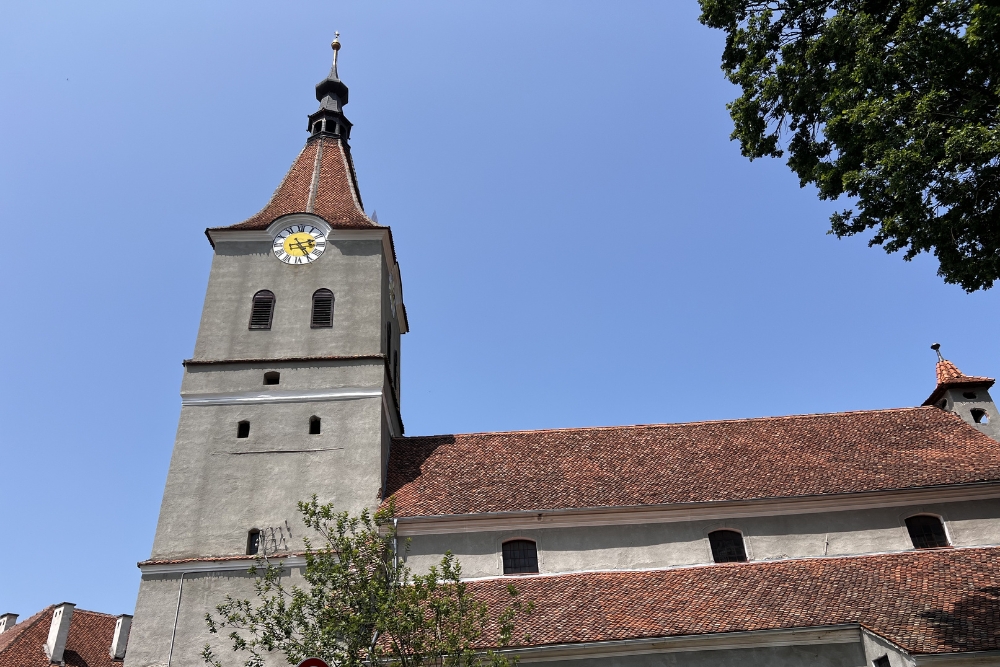
The only Protestant church still standing in Râșnov is the last visible mark of the Saxon community that built this town. It’s not a grand cathedral — it’s a working church in a small town — but it’s worth walking past. Knowing the context (a community that built here, lived here for 700 years, then mostly left within a decade) makes the building hit differently than it might otherwise.
Valea Cetății Cave
About 2.5km from the fortress, this is a stalactite cave in a wooded valley with guided tours through the main cavern. There are also zip wires outside for anyone who wants an activity alongside geology. Getting there without a car means taking a taxi or Uber. It’s worth adding if you have a full day — not worth rushing back for if you’re on a tight schedule.

© Gabriela Travels
Free Things to Do in Râșnov
- Walk up to the fortress on foot via the cobbled path — the funicular costs 60 lei return if you’d rather not hike
- Stroll Piața Unirii and the Saxon town center — no entrance fee
- Look at the fortress from below; the “Râșnov” hillside sign is visible from the road
- The train station has almost no facilities, but surprisingly good mountain views while you wait

Where to Eat
Rosenau is the go-to for a proper sit-down meal — rustic interior in the town center, traditional Romanian food from local producers. Ciorba de burtă (tripe soup) if you’re adventurous; solid, meaty mains if you’re not. Good beer stop.
But we ended in a small cafe near the main square – perfect for a quick stop. I even ordered a small pizza from kid’s menu 😀

Getting to Râșnov from Brașov
By minibus: the easiest option. Minibusses leave regularly from Brașov’s Autogara 2, roughly every hour or so. The ride takes about 30 minutes. Cheap and reliable.
By train (Regio Călători): this is the option I’d tell every budget traveler to take, at least one way. The Râșnov–Brașov line runs Regio trains — old carriages, often almost empty — and drops you right in the center of Râșnov. From the station, it’s about a 10-minute walk to the funicular. I paid 6 lei for a class 2 ticket from Râșnov to Brașov (June 2025, cash at the station).
The train back to Brașov through the foothills, in the late afternoon, with mountains on both sides of the carriage — that’s a Transylvania experience that Bran Castle can’t give you.
By taxi from Bran Castle: about 9 miles, 15 minutes, very straightforward. This is the natural circuit: Bran → Râșnov by taxi → Râșnov → Brașov by train or minibus.
Getting up to the fortress: walk the cobbled path from the town square (steep, 15–20 minutes), or take the funicular (Râșnov Ascensor) — 60 lei return, valid for 3 days.

© Gayane Mkhitaryan, Râșnov to Brașov train, Romania
Râșnov vs. Bran Castle
Since most people visit both on the same day, it’s worth being direct: Râșnov is the better fortress.
Bran has the famous name and the vampire mythology. But the Dracula connection is largely invented for tourism — Vlad the Impaler’s actual link to Bran Castle is thin. The museum is fine, the castle is photogenic, and the gift shops are relentless.
Râșnov is a real peasant fortress with a real history of sieges, survival, and 700 years of use. The story of the well alone is more compelling than anything at Bran. The views are better. The crowds are smaller. The ticket is cheaper.
Visit both — they’re 15 minutes apart. But go to Râșnov with higher expectations.
Practical Information
- How long to spend: 2–3 hours covers the fortress and town; add an hour for Dino Parc; half a day if you’re going to the cave
- Best time to visit: spring and autumn are quietest and most pleasant; summer is peak season but still far less crowded than Brașov; winter is atmospheric, and Dino Parc runs a winter program
- Getting around Râșnov: small enough to walk; taxi or Uber to the cave
- Currency: Romanian leu (lei). Have cash for the fortress entrance — card acceptance isn’t guaranteed everywhere
- Book tours: if you’d rather not piece together transport, GetYourGuide has several Brașov-based day tours that combine Râșnov with Bran and/or Peles, with flexible cancellation
- Official site: cetatea-rasnov.ro
Râșnov wasn’t on my plan. It turned out to be the part of the Brașov circuit I remember most clearly — the well story, the mountain views, the old train back through the valley. If you’re already in the area and you skip it, that’s on you.
