
Tourist Registration in Uzbekistan: What You Actually Need to Know
I’ll be honest—when we first landed in Tashkent, the tourist registration in Uzbekistan (Регистрация туристов в Узбекистане) was the last thing on my exhausted mind. I just wanted to find my hotel, collapse into bed, and start exploring the Silk Road cities I’d been dreaming about for months. But here’s what I learned over my two-week journey: understanding Uzbekistan registration rules isn’t just bureaucratic box-ticking. It’s the difference between smoothly boarding trains and avoiding fines that could derail your entire budget—or facing serious complications that mess up your carefully planned Uzbekistan itinerary.
Let me walk you through exactly how tourist registration in Uzbekistan actually works, what happened during my stays in different types of accommodation, and the mistakes I almost made that you absolutely shouldn’t.
Tourist registration in Uzbekistan is mandatory within the first 3 days (72 hours) of arrival. You need to be registered by the morning of the third working day after arrival. Miss this deadline, and you’re looking at Uzbekistan registration fines that can range from substantial to trip-ending, depending on how long you’ve overstayed the requirement.
Official Resources you might need:
- E-mehmon Online Registration: https://reg.emehmon.uz/
- Uzbekistan Ministry of Internal Affairs: https://iiv.uz/
- State Committee for Tourism Development: https://uzbekistan.travel/
- Uzbekistan Tourism Official Portal: https://uzbekistan.travel/
How Registration Actually Works: Hotels vs. Private Stays
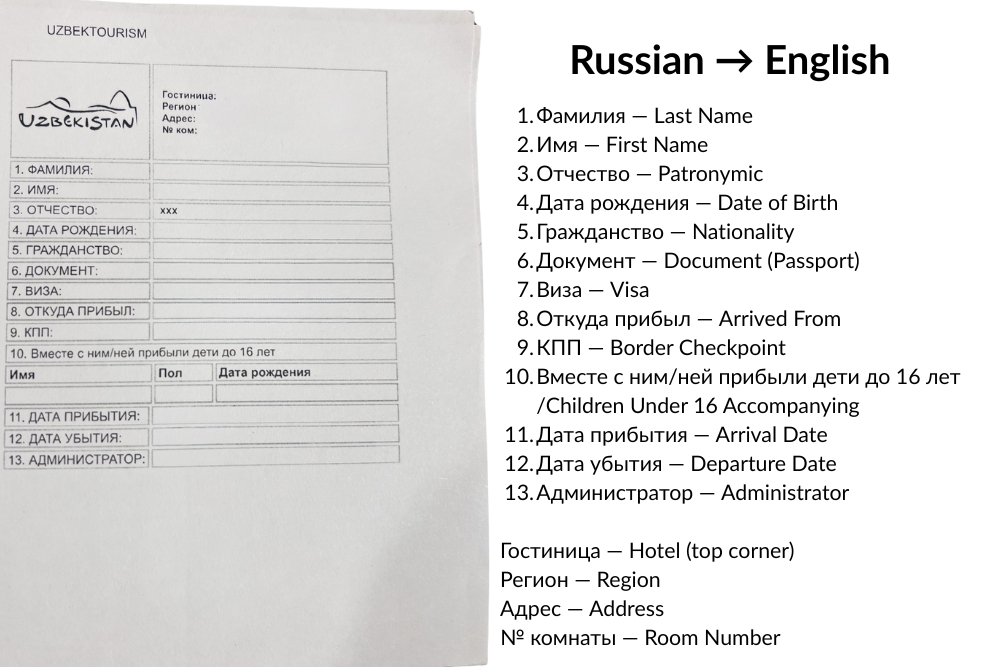
© Gayane Mkhitaryan, example of tourist registration in Uzbekistan (Регистрация туристов в Узбекистане)
If You’re Staying in Hotels (The Easy Path)
This was my situation for most of my Uzbekistan journey, and honestly, it made life infinitely simpler. When you check into a registered hotel—which includes pretty much any mid-range or upscale accommodation listed on Booking.com—Uzbekistan hotel registration happens automatically.
Here’s what actually happened at each of my hotels:
Check-in: Reception staff took my passport, entered my details into their system, and within minutes, registration was done. I didn’t fill out forms, pay extra fees (the tourist tax is usually included in your room rate), or navigate bureaucratic websites.
Check-out: The critical moment everyone forgets. At each hotel—in Tashkent, Samarkand, Bukhara, Khiva, Urgench, and Nukus—I collected a stamped registration slip or confirmation document. These small pieces of paper serve as proof of your legal presence in the country.
I kept all my registration slips in my passport throughout the trip. Nobody checked them during my stay, but I’ve heard stories from other travelers about random checks, and you absolutely need them if you’re trying to extend your visa or resolve any issues with authorities.
Pro tip: Ask for your registration slip at check-out, don’t assume they’ll offer it. At one hotel in Bukhara, I had to request it specifically—they had the document ready but weren’t automatically handing it out.
If You’re Staying in Private Accommodation (The Slightly More Complicated Path)
This is where things get interesting. Suppose you’re staying in an Airbnb, with a host family, or in any private accommodation that isn’t a registered hotel. In that case, you’ll need to handle registration through the e-mehmon online system.
I didn’t personally use this system (my budget allowed for mid-range hotels throughout), but I researched it extensively to understand how it works. Here’s what you need to know:
The e-mehmon process:
- Your host (or you, if they authorize you) needs to register through the official system at https://reg.emehmon.uz/ within 72 hours of your arrival
- You’ll need to provide passport details, arrival information, and the address where you’re staying
- A tourist tax must be paid online (amount varies but is relatively small—typically a few dollars per night)
- Once processed, you receive a confirmation document
Emehmon’s team prepared a short video with a detailed description and step-by-step instructions for registering on their website.
© Emehmon
Critical reality check: Not all private hosts are set up for this system or understand how it works. Before booking any private accommodation in Uzbekistan, explicitly confirm with your host that they can handle tourist registration through e-mehmon. If they seem confused or dismissive about the registration requirements, find another accommodation. The hassle and potential fines aren’t worth the savings.
Changing Addresses: The Update Rule You Can’t Ignore
If you move cities (which you absolutely will if you’re doing the classic Silk Road route, as I did), you need to update your registration each time you move.
The good news? If you’re staying in hotels throughout your journey like I was, this happens automatically at each new check-in. Every hotel in every city registers you fresh when you arrive. You collect a new slip at each check-out, building your paper trail of legal presence across Uzbekistan.
The complicated news? If you’re using private accommodation and e-mehmon, you or your host needs to update registration every time you change cities or addresses. Miss this step, and you’re technically violating Uzbekistan registration rules even if you were registered adequately at your first location.
What Happens If You Don’t Register: The Uzbekistan Registration Fine Reality
Failure to register within 72 hours, or to maintain proper registration as you move around the country, can result in significant fines. The exact amounts vary and can change, but I heard stories from travelers facing fines equivalent to $50-100 USD or more, substantial when you’re on a budget travel budget like mine (remember, I spent around €25 per meal on average, so a registration fine would wipe out several days of food budget).
More concerning than the fine itself? Immigration complications. If you’re caught without proper registration when trying to leave Uzbekistan, you could face delays at the airport, additional scrutiny, or, in worst-case scenarios, issues that affect future visa applications or travel to other countries.
I never personally faced registration checks beyond the standard passport control on entry and exit, but the smart move is to treat registration as non-negotiable. The small effort to collect hotel slips or ensure e-mehmon registration is complete is insurance against problems that could derail your entire journey.
