
Getting Around Naples: The Real Transportation Guide You Actually Need
Naples offers a well-developed public transportation network that’s easier to navigate than its chaotic reputation suggests. Like most European cities, Naples provides multiple transport options, including an efficient metro system, funiculars, buses, trams, and regional trains connecting to surrounding areas. The integrated ticketing system works across all public transport modes, and the infrastructure rivals other major Italian cities.
Whether you’re exploring the historic center, heading to Vomero’s hilltop attractions, or planning day trips to Pompeii and the Amalfi Coast, understanding Naples’ transport options will help you move around confidently and affordably. Here’s everything you need to know about getting around Naples.
Let me be specific about what “Naples public transport” actually means, because this confused me initially. You’re dealing with a network operated by ANM (Azienda Napoletana Mobilità) that includes:
- Metro (Metropolitana): Two main lines (Line 1 and Line 2) plus a small Line 6
- Funiculars (Funicolari): Four cliff railways connecting the waterfront to Vomero hill
- Buses: Extensive network covering areas metros don’t reach
- Trams: Limited routes but useful for specific destinations
- Regional trains: Circumvesuviana, Circumflegrea, and Cumana for day trips
What nobody tells you upfront: these all use the same ticketing system, which should make life easier, but somehow doesn’t always feel that way when you’re standing at a bus stop trying to figure out which ticket you need.
Naples public transport official website: ANM Official Site – This is your primary resource, though I’ll warn you it’s not the most user-friendly interface. The site has schedules, route maps, and official ticket information, but figuring out which bus actually goes where you need requires patience.
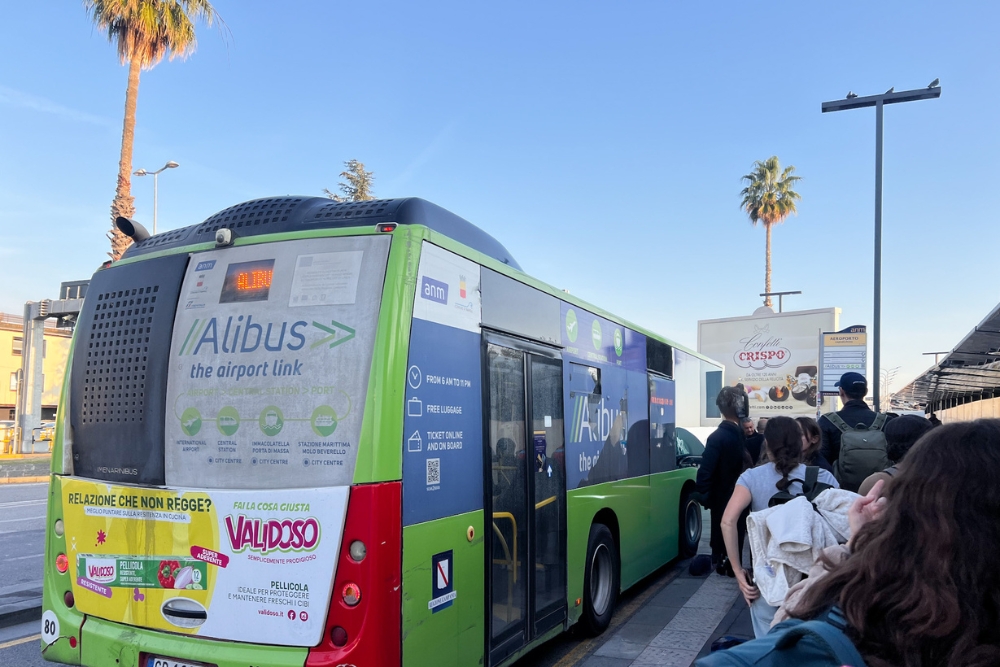
© Gayane Mkhitaryan, Alibus Naples International Airport shuttle
Naples Public Transport App: Which One Actually Works
Here’s my honest take on Naples’ public transport app options after trying several:
- ANM Official App (Unico Campania): This is the official app for Naples public transport tickets online. In theory, it’s perfect—you can buy and validate tickets digitally. In practice, it crashed twice on me, and the interface isn’t intuitive. But when it works, it saves you the trouble of hunting for tobacco shops.
- Moovit: This became my daily navigation tool. Better route planning than the official app, real-time updates (mostly accurate), and it covers all transport options in Naples. It doesn’t sell tickets, but it tells you exactly which metro, bus, or funicular to take.
- Google Maps: Surprisingly reliable in Naples for basic metro directions and walking routes. Less accurate for buses, where Moovit performed better.
- My actual strategy: I used Moovit for route planning and the ANM app for digital tickets when it worked. Keep the ANM website bookmarked as backup.
Naples Public Transport Tickets: What You Need to Know
This is where I made my biggest mistakes initially, so learn from them.
Naples public transport tickets come in several types:
Corsa Singola (Single Journey – 90 minutes): €1.10
- Valid for 90 minutes on any combination of metro, bus, tram, and funicular
- Can transfer between different transport types
- This is what you’ll use most as a visitor
- Must be validated each time you board
Biglietto Giornaliero (Daily Pass): €3.50
- Unlimited travel for 24 hours from first validation
- Worth it if you’re making 4+ journeys in a day
- I used this for full exploration days
Weekend Pass: €3.70
- Unlimited Saturday-Sunday travel
- Best value if you’re spending a weekend exploring
Three-Day Tourist Ticket: €12.50
- This is specifically marketed to tourists
- I bought this, and it paid for itself
- Covers the airport Alibus as a bonus
Where to buy Naples public transport tickets:
- Tobacco shops (tabacchi): Most reliable, found everywhere, look for the “T” sign
- Metro stations: Ticket machines accept coins and cards (sometimes)
- ANM app: When it works, most convenient
- Some newsstands: Hit or miss availability
How to pay for the bus in Naples: Here’s what confused me at first—you typically can’t pay the driver. You need to buy tickets before boarding from tobacco shops, metro stations, or the app. Then, validate your ticket at the yellow or orange machines on board. I saw tourists trying to pay drivers with €20 notes and getting turned away.
Naples public transport tap-and-go: Naples doesn’t have a comprehensive contactless payment system like London or other major cities. You can’t just tap your credit card on readers. The ANM app offers digital tickets (which function like tap-and-go once purchased), but the citywide contactless infrastructure isn’t in place yet. Keep physical tickets or pre-purchased app tickets ready.
The Metro: Your Most Reliable Option
The Naples metro became my favorite transport method because it’s predictable, air-conditioned, and some stations are genuinely beautiful—they’re called “art stations” for good reason. The Toledo station looks like an underwater cave, and Università has Roman ruins visible through glass floors.
Line 1 (Orange Line): This is the tourist line, connecting Garibaldi station (main train hub) through the historic center to Vomero and beyond. Stations include:
- Garibaldi (main station, airport bus connection)
- Università (university area, near historic center)
- Toledo (Spanish Quarter, art station)
- Municipio (port, near Palazzo Reale)
- Various Vomero stops for hilltop views
Line 2 (Blue Line): Primarily for locals commuting, but useful if you’re staying in certain areas. Less frequent and less tourist-oriented.
Line 6: Limited route, I never needed it.
Real talk: During rush hour (7:30-9:30 AM and 5-7 PM), Line 1 gets packed. I mean shoulder-to-shoulder, can’t-reach-the-handrail packed. If you’re claustrophobic or carrying luggage, time your trips differently.
Frequency: Usually every 7-10 minutes, though it can stretch to 15 minutes in off-peak. Check the electronic displays—they’re usually accurate.
Funiculars: The Locals’ Secret Weapon
The four funiculars (Centrale, Chiaia, Montesanto, Mergellina) are cliff railways connecting sea-level Naples to the Vomero hill and are absolutely the best transport options in Naples for reaching upper neighborhoods. They’re included in your standard transport ticket, run frequently (every 10-15 minutes), and save you from brutal uphill walks.
Pro tip: Locals use funiculars during rush hour to avoid car traffic jams. The 8 AM and 6 PM rides are standing-room-only but still faster than any alternative.
Buses and Trams: For When Nothing Else Works
Buses cover everywhere the metro and funiculars don’t reach, which is good news. The bad news? They’re the most confusing transport option, routes change without clear notification, and stops aren’t always obviously marked.
Best transport options in Naples involving buses:
- R2 and R3 buses: Circle routes hitting major tourist sites
- 151 bus: Connects the port to various parts of the city
- 154 bus: Goes to Museo di Capodimonte
- 140 bus: Route to Posillipo for views
How to actually use Naples buses:
- Buy your ticket before boarding (tobacco shop, station, or app)
- Board through the back doors usually (front is for exiting)
- Validate the ticket in the yellow machine immediately
- Don’t expect announcements—watch the route or ask locals
- Press the stop button before your destination
My bus reality: I took buses when necessary but relied on the metro when possible. Buses are fine during off-peak but become nightmarish during rush hour, and figuring out which stop is yours requires vigilance.
Trams: Limited routes, primarily Tram 1 along the waterfront. Helpful in reaching certain areas, but not essential for most visitors.
Regional Trains: Your Day Trip Lifeline
These aren’t technically “Naples public transport” but fall under “Campania regional transport,” and you’ll use them constantly for day trips:
- Circumvesuviana: Your lifeline to Pompeii (€3.20, 35 minutes), Herculaneum (€2.50, 20 minutes), and Sorrento (€4.90, 70 minutes). Departs from the Garibaldi station lower level.
- Reality check: It’s crowded, not air-conditioned, and pickpockets target tourists here. Keep valuables secured and visible. I watched someone’s phone get lifted while they were distracted taking photos of Vesuvius through the window. But it’s also absurdly cheap and runs frequently.
- Circumflegrea and Cumana: Connect to Pozzuoli and Campi Flegrei archaeological sites. I took the Cumana to Pozzuoli—less crowded than the Circumvesuviana, and locals were friendlier about helping confused tourists.
- Tickets: Buy from ticket windows or machines at Garibaldi. Validate before boarding. These trains run on separate ticket systems from ANM but honor some integrated tickets.
Transport Options from Naples Airport (Capodichino)
Getting from Naples airport to the city center offers several options, and I tried most of them:
- Alibus: Official airport bus to Piazza Garibaldi (central station) and Piazza Municipio (port area). Runs every 20 minutes, takes 30-40 minutes depending on traffic, costs €5. This is included in the 3-day tourist ticket, which surprised me pleasantly. Buy tickets at the airport from the ticket machines or the ANM desk before boarding.
- Taxi: Fixed rates exist (€19 to the city center, €23 to the seafront), but enforce them. When I arrived at the terminal, there were also shared taxis (€6 per person), so on the way back, I took this option.
- Metro Line 1: Doesn’t go directly to the airport. You’d need the Alibus to Garibaldi, then the metro. Pointless detour.
- Bus alternatives: Local bus 3S also connects the airport to the city for €1.10 (standard ticket), but it’s slower and less reliable than Alibus.
My recommendation: Alibus for budget, official taxi if you have heavy luggage or arrive late at night when buses are less frequent.
Walking: The Underrated Transport Option
Central Naples is surprisingly walkable once you understand the layout. From the port area (Castel Nuovo, Palazzo Reale) to Spaccanapoli is 20 minutes on foot. The Toledo metro station to Piazza Plebiscito is a 10-minute walk through the Spanish Quarter streets.
Reality check: Naples streets are chaotic. Sidewalks disappear randomly, scooters use pedestrian areas, and crossing streets feels like a trust exercise. But walking lets you discover those hidden pizzerias and baroque churches that public transport passes by.
My strategy: I walked for nearby destinations (under 20 minutes), used the metro for anything involving hills, and saved buses for specific sites off the beaten path.
Taxis: Use Them Wisely
Naples taxis have a reputation problem, and some of it is deserved. But they’re not all scammers, and sometimes they’re the practical choice.
Official taxis are white with a taxi sign on top and a meter inside. Licensed drivers have an ID displayed. Uber doesn’t operate in Naples—it’s traditional taxis or nothing.
Fixed rates that should be respected:
- Airport to city center: €19-23 (depending on exact destination)
- City center to train station: Around €10-15
- Within city center: Rarely more than €15
Ferries: Your Gateway to Islands and Coast
While not technically city transport, ferries from Molo Beverello port (reachable by metro to Municipio or walking from the port area) are essential for:
Islands:
- Capri (50-80 minutes, €20-30 depending on ferry vs. hydrofoil)
- Ischia (50-90 minutes, €15-25)
- Procida (35-50 minutes, €15-20)
Coast:
- Sorrento, Positano, Amalfi (seasonal, April-October). In November there were less options available, so check the schedule beforehand.
Companies: Caremar, SNAV, NLG, Alilauro
Booking: Buy at the port or online through Direct Ferries, company websites
Hop-On-Hop-Off Buses: Tourist Convenience or Waste?
The red double-decker City Sightseeing buses circle the major sites, and I have mixed feelings about them. They’re convenient if you’re overwhelmed by regular transport options, want commentary, and are only in Naples for a short period of time. They’re also relatively expensive (around €22-28 for 24 hours) compared to a €3.50 daily transport pass.
I took one to test it—useful for orientation on day one, but I didn’t use it again. Once you understand the metro and funicular system, public transport is more flexible and much cheaper. Plus, you miss the chaos and character that make Naples interesting.
Worth it if: You have mobility issues, traveling with kids, or only have one rushed day.
Skip it if: You’re comfortable with public transport and want authentic experiences.

© Gayane Mkhitaryan, Napoli hop on hop off buses
What I Wish I’d Known: Practical Transport Lessons
- Buy multiple tickets at once. Finding an open tobacco shop at 8 PM on a Sunday when you need a bus ticket is a nightmare. I learned to stock up.
- Download offline maps. Data coverage is fine, but metro stations often have dead zones. Offline Google Maps saved me multiple times.
- Validate every time. Even if you have a pass, validate it on first use. Ticket inspectors are frequent, and fines are steep (€50+). I saw two tourists get fined for unvalidated tickets they’d legally purchased.
- The ANM app frustrations are real. Have a backup plan. When it crashed while I was trying to buy a ticket for an approaching bus, I learned always to keep one spare physical ticket.
- Peak hours are peak chaos. If you’re claustrophobic, time-sensitive, or carrying valuables, avoid the metro 8-9 AM and 5:30-7 PM.
Night transport is limited. Most metros and funiculars stop by 11 PM. Night buses exist but are infrequent and confusing. Budget for a taxi if you’re out late.
The Best Transport Options in Naples: My Final Verdict
After a few days of testing everything, here’s my honest ranking:
- Best overall: Metro Line 1 + funiculars. Reliable, frequent, affordable, and they actually take you where tourists need to go.
- Best value: 3-day tourist ticket (€12.50) if you’re staying a few days. It pays for itself quickly and eliminates the stress of constantly buying tickets.
- Most essential for day trips: Circumvesuviana trains, despite their chaos. No other affordable option for Pompeii and Sorrento.
- Most overrated: Hop-on-hop-off buses. Just learn the basic metro routes.
- Most underrated: Walking. Naples reveals itself on foot in ways transport misses.
When to splurge on taxis: Late night, heavy luggage, time constraints, or airport transfers with more than one person splitting costs.
Useful Resources:
- ANM Official Website: www.anm.it (Naples public transport)
- Unico Campania: www.unicocampania.it (Integrated ticket system)
- Trenitalia: www.trenitalia.com (National trains)
- EAV (Circumvesuviana): www.eavsrl.it (Regional trains)
- Direct Ferries: www.directferries.com (Ferry bookings)
- Moovit App: Available on iOS and Android
- Naples Airport: www.aeroportodinapoli.it (Transport connections)
Booking Platforms:
- Omio: Multi-transport booking platform
- Trainline: Train ticket comparisons
- GetYourGuide: Tours and experiences
- Viator: Day trips and activities
